Gestalter
Tiny, mighty learning tools for the practice of Gestalt in leadership and organizational development
gestalter.vercel.app/ ↗Description
A growing collection of tiny, mighty learning tools for the practice of Gestalt in leadership and organizational development.
So far I’ve launched:
- GestalterGPT: A teacher and thinking partner, designed for fellow iGold peers.
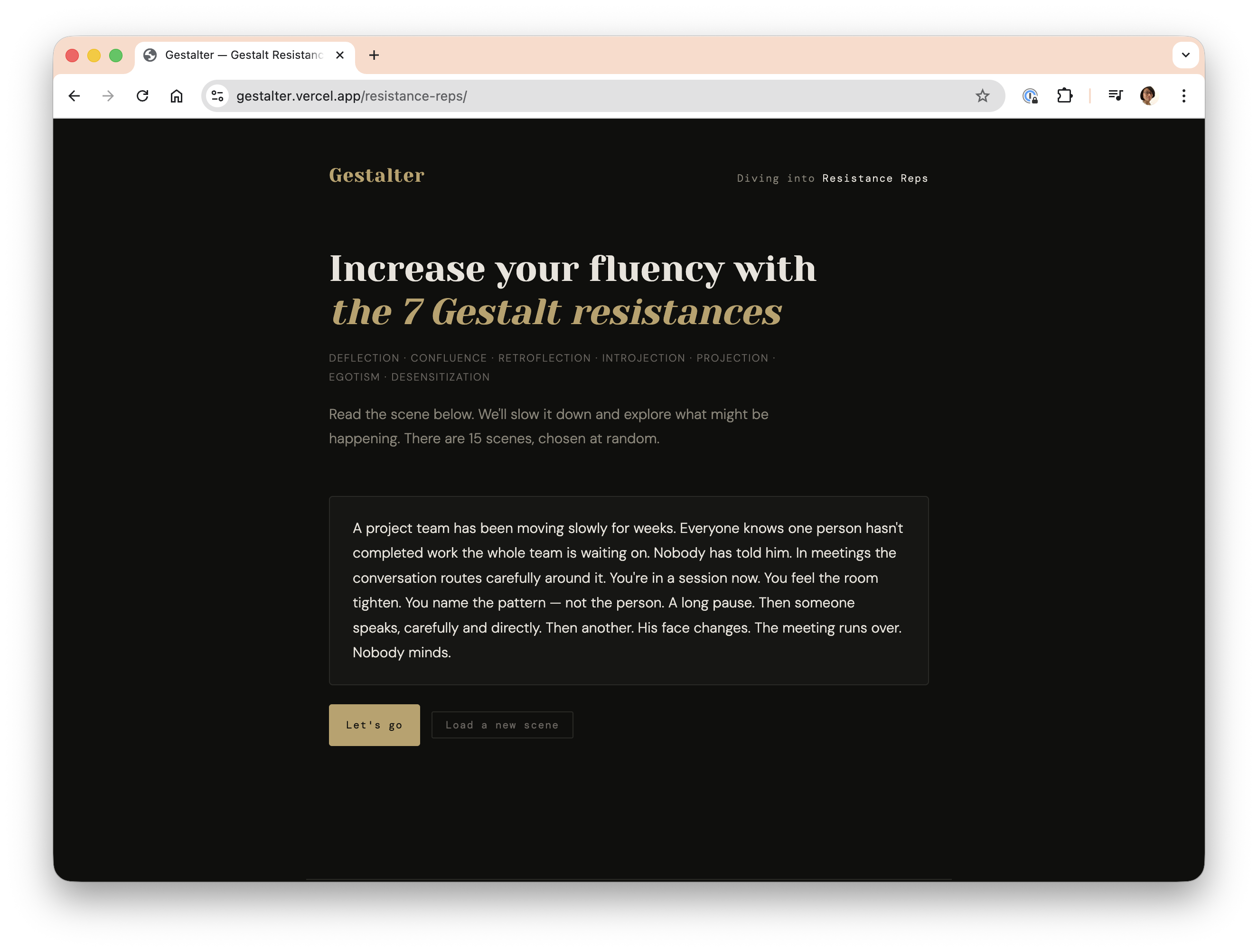
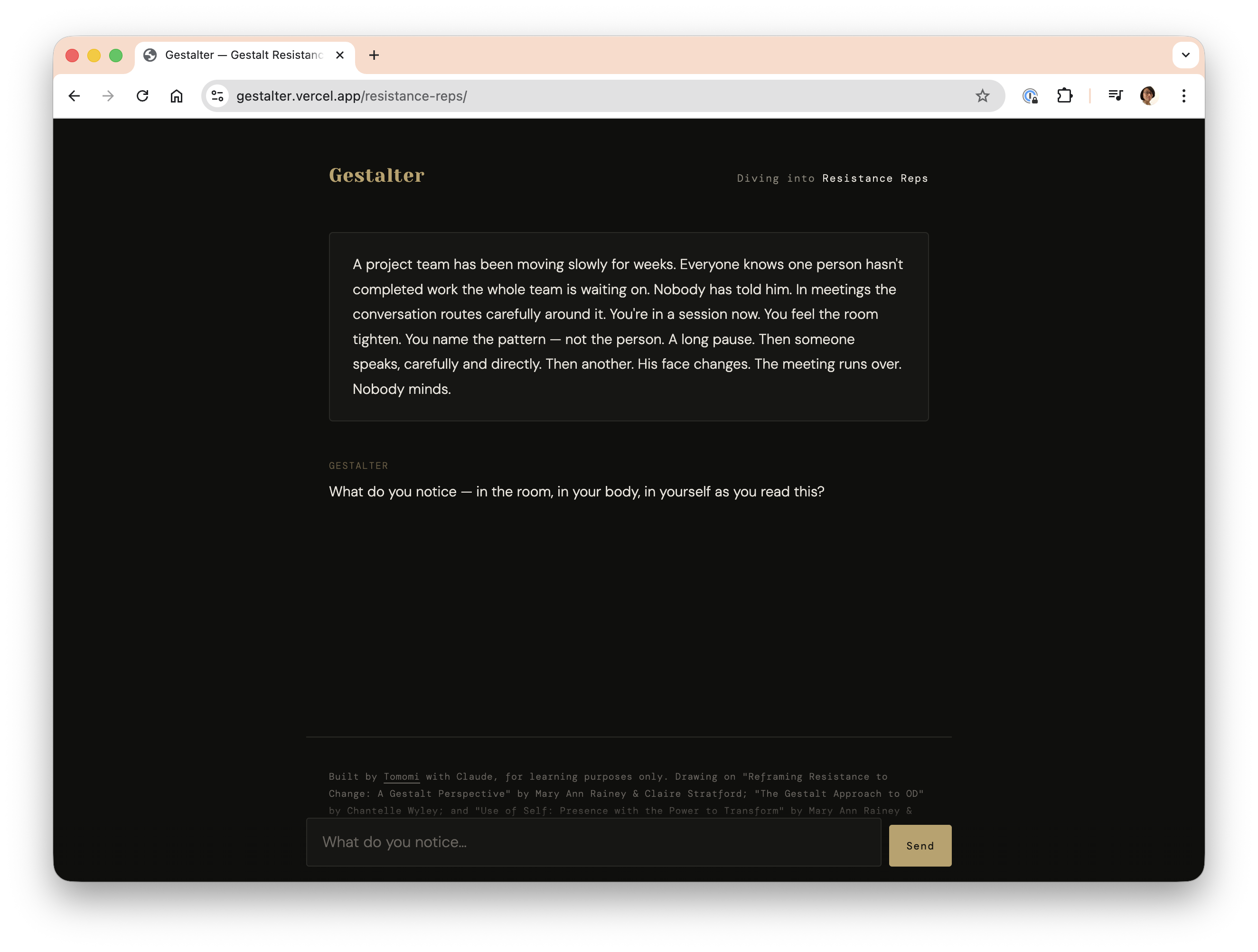
- Resistance Reps: A scenario-based practice tool for spotting resistance in the workplace.
Want to collaborate?
I'm keen to make a few more tools in 2026 while I'm furthering my studies. If you are a fellow Gestaltist and have ideas, especially if you have a collection of written text or simple models that might become the basis of a tool, let's chat!
Send me a note ↗Up next
- Intervention moves: a taxonomy of traffic control moves (Track, Redirect, Compress, Hold, Challenge, Ground)
- Gestalt OD Library: a visual way to explore key references in this field
- A v3 of the design principles that I can publish a write-up on
What it looks like
Design principles v2
-
Felt sense before framework: A concept must be preceded by an experience that activates it. Theory and labels arrive after the learner has felt something.
-
The scene chooses you: The learner does not browse or select. Randomness and constraint are features, not limitations.
-
Implication over observation: The learner is always inside the situation, not watching it. Content places the learner inside a system they are part of, never outside one they are studying.
-
The body is data: Somatic experience is valid learning data. Gestalter helps the learner be grounded in their body as part of the learning.
-
One thing at a time: No feature asks two things at once or opens a new thread before the current one is followed. The cycle of experience requires completion before a new figure can emerge.
-
Show before asking: Gestalter offers what it sees before asking what the learner sees, so that it doesn’t extract without offering. Showing its hand makes it safe for the learner to show theirs.
-
Incompleteness is generative: Learning lives in the discomfort of the open question, not in the relief of the answer. Premature resolutions work against the learning.
-
Separate the felt from the conceptual: Experience and consolidation are different modes and must not occupy the same moment. Any summary or reference feature lives in its own distinct space.
-
Minimum viable intervention: The smallest intervention that creates awareness is always preferred over the larger one that tells the learner what to think. Practice restraint from adding more features.
-
The tool is a system too: Each tool embodies the practice it teaches. When it deflects, rushes, or tells instead of asks, it works against itself. Every tool is also a system and is held to the same scrutiny as the systems it illuminates.
-
The measure of success is independence: Gestalter is designed to make itself unnecessary. When the practitioner recognizes the patterns they are learning in real rooms without needing the tool, it has done its job.
-
Hold multiple realities: These tools do not claim authority over interpretation. Any feature that names or analyses carries epistemological humility.
Feedback
“I want you to know, Tomomi, the GestalterGPT is fucking awesome.”
— A friendly friend